Portable X-ray systems provide critical field inspection capabilities for explosive ordnance disposal (EOD), border security, forensics, and industrial NDT where fixed equipment is impractical. Modern battery-operated digital systems weigh 15-30kg complete, offering 2-4 hour runtime with real-time wireless image transmission.
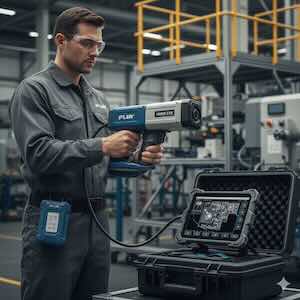
Battery-operated portable X-ray system for field inspection
System Categories
1. EOD (Explosive Ordnance Disposal) Systems
Specialized equipment for bomb technicians and first responders:
Critical Applications
- Suspicious Package Inspection: IED identification without physical contact
- Bomb Threat Response: Determine internal composition of suspect items
- Render-Safe Operations: Identify firing trains and booby traps
- Post-Blast Investigation: Fragment and evidence recovery
- VIP Protection: Advance security sweeps of venues
Technical Specifications (EOD Systems)
| Parameter | Specification |
|---|---|
| X-Ray Energy | 50-160 kVp (selectable) |
| Battery Runtime | 2-4 hours continuous operation |
| System Weight | 15-25 kg complete (generator + detector + tablet) |
| Detector Type | Flat-panel digital or wireless CR plate |
| Image Display | Tablet/laptop (wireless or cable) |
| Penetration | 30-40mm steel at 160kVp |
| Operating Distance | Remote operation from 30+ meters |
2. Border and Customs Inspection
Portable systems for remote checkpoints and vehicle inspection:
Use Cases
- Vehicle Panel Inspection: Detect concealed contraband in doors, fuel tanks
- Cargo Verification: Field inspection of suspicious shipments
- Agricultural Contraband: Detection of prohibited plant/animal products
- Currency Smuggling: Identification of bulk cash concealment
- Remote Border Crossings: Temporary deployment at low-volume locations
3. Industrial Field Radiography
On-site NDT for welding, pipeline, and structural inspection:
Applications
- Pipeline Welds: API 1104 compliance inspection
- Pressure Vessel Fabrication: ASME Code Section VIII field welds
- Structural Steel: AWS D1.1 weld quality verification
- Aerospace Field Repair: On-aircraft component inspection
- Construction Inspection: Concrete rebar placement, grout fill verification
4. Forensic and Archaeological Applications
- Crime Scene Investigation: Sealed container examination without opening
- Artifact Analysis: Non-destructive examination of historical objects
- Mummy Studies: Internal structure visualization
- Customs Seizures: Document contraband without disturbing evidence
Leading Manufacturers
Smiths Detection
HXRD (Handheld X-Ray Diffraction) Series
- HXRD 3020: Compact EOD system with wireless detector
- Weight: 18kg complete system
- Features: Encrypted wireless transmission, GPS tagging
- Battery: Hot-swappable lithium-ion (3-hour runtime)
Vidisco
RayzorX Series
- RayzorX Pro: Digital portable system with real-time imaging
- Unique Feature: Ruggedized for harsh environments
- Detector: Wireless flat-panel with instant image preview
- Applications: EOD, border patrol, industrial NDT
MinXray (Source-Ray)
HF Series
- HF100+ Lite: Lightweight EOD system (12kg generator)
- Energy: 50-100 kVp with constant potential
- Market Focus: Law enforcement and security applications
- Cost: Entry-level pricing for budget-conscious agencies
Golden Engineering (XRS-4)
XRS-4 System
- XRS-4: High-energy portable (up to 320kVp)
- Applications: Heavy industrial NDT, thick-section welds
- Trade-off: Heavier (40kg) but higher penetration
- Power: AC or battery operation
Technology Evolution
From Film to Digital
| Feature | Film-Based (Legacy) | Digital (Current) |
|---|---|---|
| Image Time | 30-60 minutes (develop film) | Seconds (instant display) |
| Field Usability | Requires darkroom or processor | Immediate feedback, retake capability |
| Cost per Image | $5-$15 (film + chemicals) | $0 (unlimited exposures) |
| Image Enhancement | None (fixed exposure) | Digital processing, zoom, contrast adjust |
| Transmission | Physical film transport | Wireless image transfer to command post |
Modern Digital Detector Technologies
- Flat-Panel Detectors: Real-time imaging, ruggedized enclosures
- CR Plates: Computed radiography, lower cost alternative
- Wireless Connectivity: Bluetooth/WiFi transmission to tablets
- Encrypted Transmission: Secure image transfer for sensitive operations
Operational Deployment
EOD Tactical Considerations
Safe Operating Distance
Bomb technicians operate portable X-ray remotely:
- Minimum Distance: 30 meters (radiation safety + blast protection)
- Remote Trigger: Cable or wireless activation
- Wireless Image: Real-time transmission to operator tablet
- Robot Integration: Systems mountable on EOD robots for placement
Typical EOD Setup
- Reconnaissance: Visual assessment of suspicious package
- Robot Deployment: Place X-ray generator and detector (optional)
- Manual Placement: Or technician places equipment at safe distance
- Withdrawal: Retire to safe distance (30m minimum)
- Exposure: Activate X-ray remotely, capture image
- Analysis: Review image for threat indicators (wires, batteries, timers)
- Decision: Render-safe, controlled detonation, or clear
Border Patrol Operations
- Mobile Checkpoints: Deploy at temporary roadblocks
- Vehicle Sweeps: Inspect doors, quarter panels, fuel tanks
- Cargo Containers: Spot-check specific items from shipments
- Rapid Deployment: 10-15 minute setup from vehicle transport
Industrial Field Radiography
Pipeline Weld Inspection
- Setup: Generator on one side of pipe, detector opposite
- Exposure Technique: Panoramic or double-wall technique
- Acceptance Criteria: API 1104 defect classification
- Documentation: Digital images stored with weld identification
- Radiation Safety: Exclusion zone established per state regulations
Radiation Safety and Compliance
Regulatory Requirements
State Licensing (U.S.)
- Radiographer License: State-issued certification required
- Equipment Registration: Annual registration with health department
- Training: 40-hour radiography course + exam
- Reciprocity: Some states recognize other state licenses
Safety Equipment
- Dosimetry: Film badge or electronic dosimeter required
- Survey Meter: Radiation detector for area monitoring
- Barrier Tape: Establish exclusion zone boundaries
- Signage: "CAUTION - X-RAY EQUIPMENT" warnings
- Collimators: Beam limiting devices to reduce scatter
Exclusion Zone Calculation
Safe distance depends on X-ray energy and exposure time:
| X-Ray Energy | Minimum Exclusion Radius |
|---|---|
| 50-100 kVp | 3-5 meters |
| 100-160 kVp | 5-10 meters |
| 160-300 kVp | 10-20 meters |
Note: Actual exclusion zones calculated using inverse square law and measured with survey meter
Cost Analysis
Equipment Investment
| System Type | Price Range (USD) |
|---|---|
| Basic EOD System (CR) | $25,000 - $40,000 |
| Advanced EOD (Digital Panel) | $50,000 - $80,000 |
| Industrial NDT System | $30,000 - $60,000 |
| High-Energy Field System (320kVp) | $70,000 - $120,000 |
Operating Costs
- Battery Replacement: $500-$1,000/year
- Maintenance: $2,000-$5,000/year
- Licensing/Training: $1,000-$3,000/technician/year
- Dosimetry Service: $100-$300/technician/year
Advantages and Limitations
Advantages
- Mobility: Inspection at remote locations without fixed infrastructure
- Rapid Deployment: Operational within minutes
- Safety: Non-destructive examination of hazardous items
- Versatility: Wide range of applications from EOD to NDT
- Digital Imaging: Instant results with wireless transmission
Limitations
- Limited Penetration: 30-40mm steel maximum (vs. 300+mm for fixed systems)
- Battery Life: 2-4 hours limits extended operations
- Image Quality: Lower resolution than stationary systems
- Weather Sensitivity: Rain/moisture can damage electronics
- Radiation Safety: Requires trained operators and exclusion zones
Future Developments
Emerging Technologies
- Lighter Systems: Carbon fiber construction reducing weight to 8-10kg
- Longer Battery Life: Advanced lithium-polymer batteries (6-8 hours)
- AI Threat Recognition: Automated IED component identification
- 3D Imaging: Portable CT reconstruction capability
- Drone Integration: Aerial deployment for difficult-to-access areas