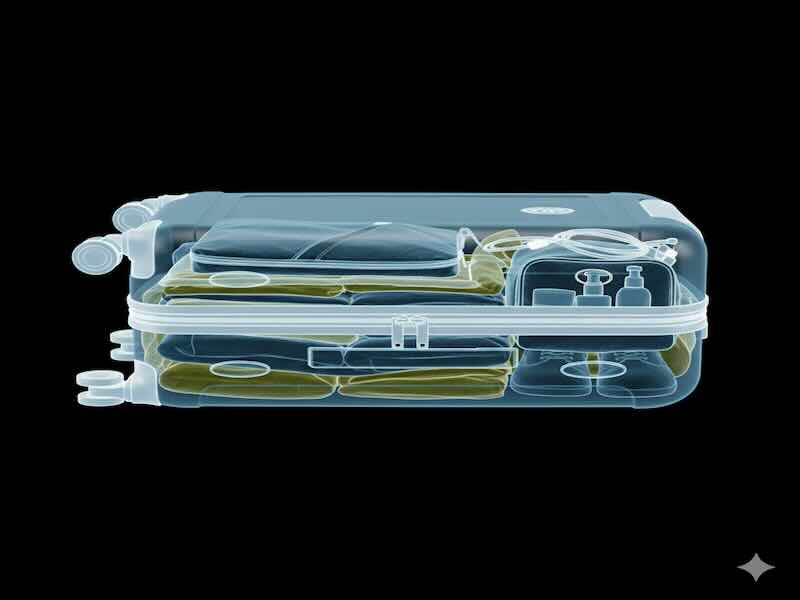
How Dual-Energy X-Ray Screening Detects Threats
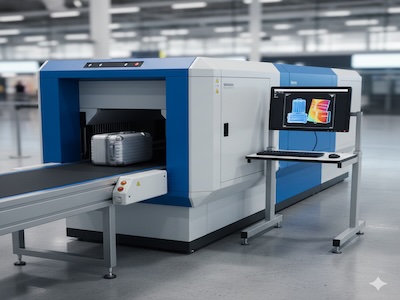
Most baggage and parcel scanners in use today are dual-energy transmission X-ray systems. A fan-shaped X-ray beam passes through the bag as it moves along a conveyor, and a line of detectors on the far side measures how much of the beam gets through. Measuring that attenuation at two different energy bands lets the system estimate not just how much material is in the way, but roughly what kind of material it is.
Physical principles
A single-energy scanner produces a greyscale image that shows only how strongly each part of the bag absorbs X-rays — a thick book and a thin steel plate can look similar. Dual-energy scanners typically use one X-ray tube (commonly operated somewhere around 140–160 kV) and a dual-layer detector: a thin front layer records mostly low-energy photons, and a thicker rear layer behind a filter records mostly high-energy photons. Low-atomic-number (low-Z) materials such as plastics, paper and most explosives absorb the two energy bands differently from high-Z materials such as metals. The ratio of the two signals gives an estimate of the effective atomic number (Zeff), which the software maps to colour.
The usual convention is orange for organic materials, green for mixtures and light inorganic materials, blue for metals, and black where the bag is too dense for the beam to penetrate. Our guide to X-ray baggage scanner colours explains the convention and its limits in more detail.
Operator support: TIP and automated detection
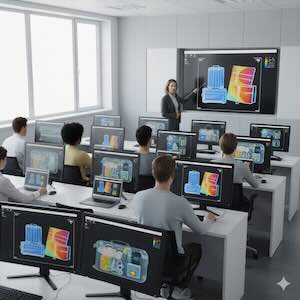
Human screeners still make most decisions at a checkpoint. To keep their attention on rare threats, many authorities use Threat Image Projection (TIP), which inserts fictional threat images into the stream of real bag images and records whether the screener spots them. Many scanners also offer automated explosive detection or object-recognition software that highlights areas for the operator to examine. When an alarm cannot be cleared on screen, the bag is searched by hand and may be swabbed for explosive trace detection (ETD).
Regulation and approval
Two separate kinds of rule apply. Radiation safety rules govern the equipment as a radiation-emitting product — in the United States, cabinet X-ray systems (including baggage scanners) must meet the FDA performance standard in 21 CFR 1020.40, which limits radiation leaking from the cabinet. Security performance rules decide whether a machine may be used for aviation screening: TSA maintains qualified product lists for checkpoint and checked-baggage equipment and the Air Cargo Screening Technology List, while in Europe equipment is tested through the ECAC Common Evaluation Process against standards set under EU aviation security law. See regulations for the overview.
CT and 3-D imaging
Computed tomography (CT) scanners rotate the source and detectors around the bag and reconstruct a 3-D image that the operator can rotate and slice. CT has long been the standard for checked baggage explosive detection, and since around 2018–2019 smaller CT units have been rolled out at passenger checkpoints in the US, UK, EU and elsewhere. Where a CT unit is approved for it, passengers may be allowed to leave laptops and sometimes liquids in their bags — but the rules vary by airport and country, so always check the local guidance. Details are on the CT scanner page.
Cargo, containers and industry
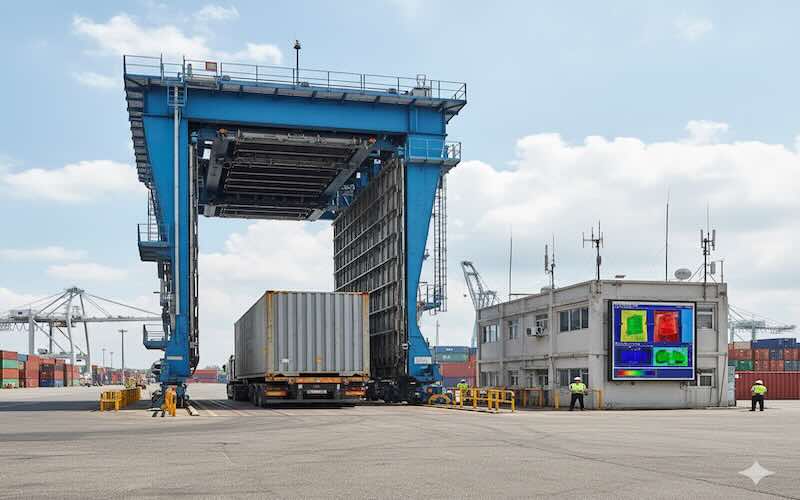
Freight uses the same physics at much larger scale. Pallet and air-cargo scanners resemble enlarged baggage machines, while sea containers and trucks are imaged with high-energy linear accelerator (linac) sources in the MeV range, which require dedicated shielding and exclusion zones. See cargo screening, container scanners and what happens during a customs container X-ray. Industrial radiography uses X-ray and gamma sources to inspect welds, castings and components — see industrial NDT.
Is it safe?
Baggage scanners are enclosed, shielded cabinets; the dose to a passenger standing beside one is negligible, and the dose to items inside is far too low to harm food, medicine or electronics. Undeveloped high-speed film is the main exception worth knowing about — see what airport X-ray does to film, electronics and food and our radiation safety overview.
Want to test yourself? Try the X-ray screening practice quiz, or browse the glossary.
Last reviewed on 2026-10-04.