Cargo X-ray screening represents critical infrastructure for global trade security, customs enforcement, and supply chain integrity. High-energy transmission systems inspect everything from air freight pallets to fully loaded 40-foot ISO containers, detecting contraband, weapons, explosives, and agricultural violations without physical unpacking.
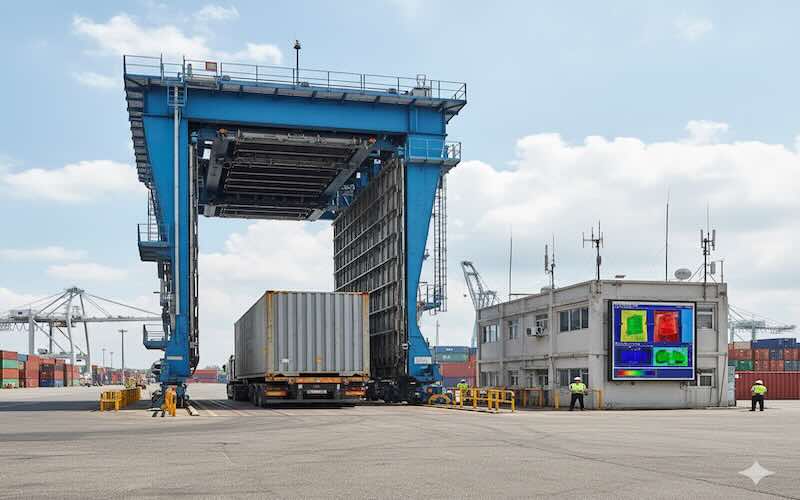
Drive-through cargo container X-ray inspection portal with LINAC technology
Cargo Screening Technology Categories
1. Air Cargo Screening
TSA mandates 100% screening of cargo transported on passenger aircraft under the Certified Cargo Screening Program (CCSP).
Approved Screening Methods
- X-Ray Systems: TSA Air Cargo Screening Technology List (ACSTL) certified equipment
- Explosive Trace Detection (ETD): Ion mobility spectrometry for residue analysis
- Explosive Detection System (EDS): CT-based automated threat recognition
- Physical Search: Manual inspection by certified cargo screeners
- Canine Teams: TSA-certified explosive detection dogs
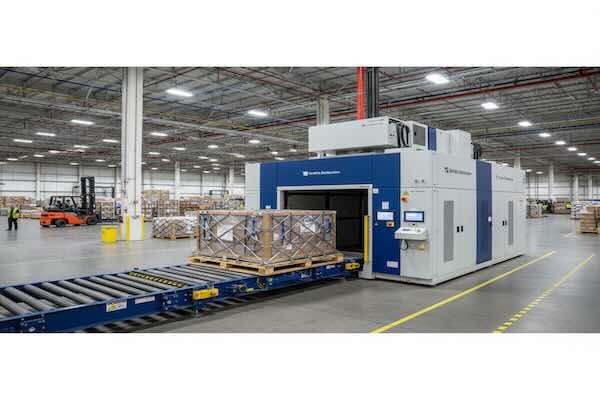
Air cargo pallet scanner for ULD and freight screening
Air Cargo X-Ray Specifications
| System Type | Energy | Penetration | Application |
|---|---|---|---|
| Pallet/ULD Scanner | 160-225 keV | 75-100mm steel | Air freight pallets, unit load devices |
| Tunnel Scanner | 180-300 keV | 150mm steel | Large cargo, consolidated shipments |
| CT Cargo EDS | 120-160 keV | 100mm steel | Automated explosive detection |
2. Maritime Container Inspection
Seaports process over 95% of global trade volume. High-energy X-ray and gamma-ray systems scan intermodal containers for customs enforcement and national security.
Container Security Initiative (CSI)
U.S. Customs and Border Protection (CBP) operates the Container Security Initiative at 60+ foreign ports, pre-screening U.S.-bound cargo before departure.
- Participating Ports: Rotterdam, Hamburg, Singapore, Hong Kong, Shanghai, Dubai
- Target Criteria: Risk-based algorithms flag high-risk shipments
- Technology: Mobile VACIS (Vehicle and Cargo Inspection System) and fixed gantry scanners
- Throughput: 40-60 containers per hour for drive-through systems
LINAC vs. Isotope Sources
| Parameter | LINAC (Linear Accelerator) | Cobalt-60 Isotope |
|---|---|---|
| Energy | 3-9 MeV (adjustable) | 1.17 & 1.33 MeV (fixed) |
| Penetration | 300-400mm steel | 200-250mm steel |
| Source Control | Electrical on/off (instant) | Mechanical shutter (always emitting) |
| Regulatory Burden | Radiation machine (state registration) | Radioactive material (NRC license) |
| Operational Cost | Higher electricity, lower long-term | Source replacement every 5-10 years ($500K+) |
| Security Risk | No radioactive material | Potential dirty bomb material (theft concern) |
3. Land Border Crossings
CBP operates over 300 Non-Intrusive Inspection (NII) systems at U.S. land borders and ports of entry.
VACIS Technology
Vehicle and Cargo Inspection System uses gamma-ray imaging for rapid screening:
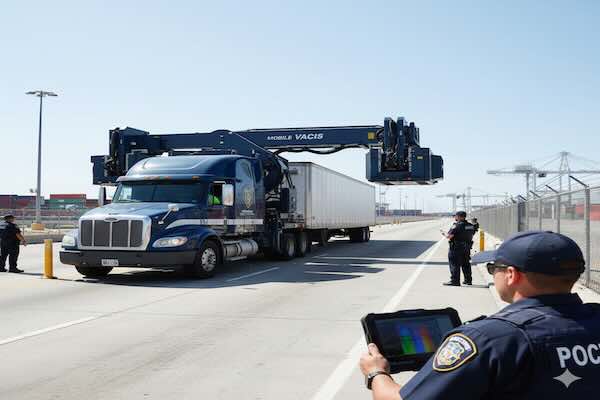
Truck-mounted mobile VACIS system for border security operations
- Mobile VACIS: Truck-mounted system deployable to temporary locations
- Fixed Portal: Drive-through gantry for high-volume screening
- Z Portal: Backscatter technology for vehicle occupant detection
- Rail VACIS: Specialized systems for freight rail inspection
Inspection Throughput
- Primary Inspection: 3-5 minutes per commercial truck
- Secondary Screening: 15-30 minutes if anomalies detected
- Physical Offload: 2-4 hours for complete container unloading (rare)
Contraband Detection Applications
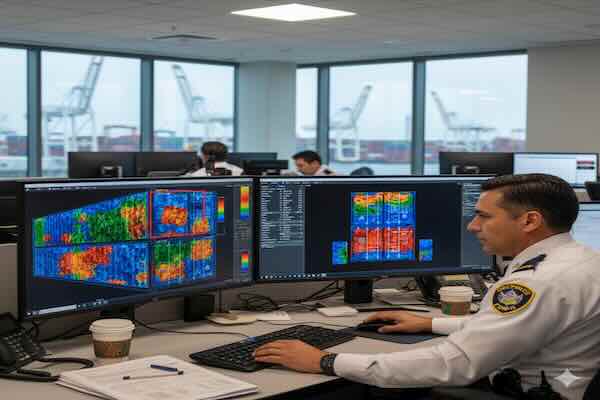
Operator workstation displaying cargo X-ray scan for anomaly detection
Narcotics Trafficking
X-ray screening identifies hidden compartments and anomalous density patterns consistent with drug concealment:
Common Concealment Methods
- False Compartments: Welded cavities in vehicle frames, fuel tanks, doors
- Commodity Loads: Drugs mixed with legitimate cargo (produce, electronics)
- Body Packing: Internal concealment detected by backscatter or millimeter wave
- Containerization: Palletized narcotics within ocean freight
Detection Indicators
- Density anomalies in organic materials (drugs appear darker than typical cargo)
- Geometric irregularities (straight edges in natural products)
- Void spaces inconsistent with manifest descriptions
- Metal reinforcement patterns suggesting hidden compartments
Weapons and Ammunition
Small arms trafficking and illegal weapons exports appear as high-density metallic signatures:
- Rifles and Handguns: Distinctive barrel profiles and receiver shapes
- Ammunition: Regular geometric patterns of cartridges in boxes
- Components: Disassembled firearms often harder to identify than complete weapons
- Heavy Weapons: Anti-tank weapons, RPGs detectable by size and density
Agricultural Violations
USDA Animal and Plant Health Inspection Service (APHIS) uses X-ray to detect prohibited agricultural products:
- Fruits and Vegetables: Pest-carrying produce from restricted regions
- Meat Products: Detection of foot-and-mouth disease, swine fever risks
- Live Animals: Illegal wildlife trafficking and endangered species
- Plant Materials: Seeds, soil, and plant matter carrying invasive species
Currency and Financial Instruments
Bulk Cash Smuggling (BCS) operations detect unreported currency exceeding $10,000:
- X-Ray Signature: Currency appears as uniform density rectangular bundles
- Concealment Locations: Vehicle panels, spare tires, electronics cavities
- Detection Rate: Approximately $100M+ seized annually at U.S. borders
Regulatory Compliance Framework
U.S. Regulations
TSA - Air Cargo Security
- 49 CFR Part 1548: Indirect Air Carrier Security
- 49 CFR Part 1549: Certified Cargo Screening Program
- Security Directive 1546-04-05: All-Cargo Aircraft Operator Security
CBP - Border Security
- 19 CFR Part 12: Customs and Border Protection Regulations
- SAFE Port Act: Mandates 100% container scanning (phased implementation)
- C-TPAT: Customs-Trade Partnership Against Terrorism (voluntary certification)
DOT - Radiation Safety
- 49 CFR Part 173: Transportation of radioactive materials (isotope sources)
- State Regulations: Radiation machine registration (LINAC systems)
- ANSI N43.17: Radiation safety standard for industrial radiography
International Standards
World Customs Organization (WCO)
- SAFE Framework: Standards to Secure and Facilitate Global Trade
- Data Model: Harmonized electronic customs declarations
- Authorized Economic Operator (AEO): International trusted shipper program
International Maritime Organization (IMO)
- ISPS Code: International Ship and Port Facility Security Code
- SOLAS Convention: Safety of Life at Sea (container weight verification)
Operational Deployment Models
Fixed Installation Systems
Permanent infrastructure for high-volume screening:
Portal/Gantry Configuration
- Drive-Through Design: Vehicle/container passes through X-ray tunnel
- Dual-View Imaging: Horizontal and vertical beam angles for complete coverage
- Automated License Plate Recognition (ALPR): OCR integration for tracking
- Radiation Monitoring: Portal monitors detect radioactive materials
- Throughput: 40-80 vehicles per hour
Infrastructure Requirements
- Footprint: 30-50 meters length for drive-through lane
- Shielding: Concrete barriers (1-2m thick) or exclusion zones (15-30m radius)
- Power: 50-150 kW for LINAC systems
- HVAC: Climate control for electronics and operator stations
- IT Infrastructure: Network connectivity for central monitoring and database integration
Mobile/Relocatable Systems
Flexible deployment for temporary operations:
Mobile VACIS Advantages
- Rapid Deployment: Operational within 30 minutes of arrival
- Event Security: High-profile venues, special events, emergency response
- Multi-Site Operations: Rotate between low-volume border crossings
- Cost Efficiency: Shared resource across multiple locations
Deployment Considerations
- Radiation Safety Zone: Temporary barriers and signage
- Generator Power: Self-contained or local grid connection
- Weather Protection: Tented operator stations for outdoor use
- Transportation: Requires specialized transport vehicle or trailer
Advanced Detection Technologies
Dual-Energy Material Discrimination
High-energy dual-energy systems (3/6 MeV or 6/9 MeV) enable atomic number determination for large cargo:
- Organic Highlighting: Drugs, explosives, agricultural products appear in distinct colors
- Shielding Detection: Lead-lined compartments stand out as high-Z materials
- Commodity Verification: Confirm manifest accuracy (e.g., electronics vs. scrap metal)
Backscatter Imaging
Detects low-density surface concealment invisible to transmission X-ray:
- Surface Contraband: Drugs taped to vehicle exteriors or body packing
- Organic Materials: Explosives, currency, agricultural products
- Occupant Detection: Identifies human presence in cargo compartments
Computed Tomography (CT)
3D volumetric imaging for complex threat analysis:
- Slice Reconstruction: Virtual dissection without physical unpacking
- Automated Threat Detection: AI-driven explosive and weapon recognition
- Density Mapping: Precise material identification beyond dual-energy
- Limitation: Higher cost, lower throughput than transmission systems
Cost-Benefit Analysis
Capital Equipment Costs
| System Type | Cost Range (USD) | Annual O&M |
|---|---|---|
| Air Cargo Pallet Scanner | $300,000 - $600,000 | $40,000 - $60,000 |
| Mobile VACIS (Gamma) | $1.5M - $2.5M | $100,000 - $150,000 |
| Fixed Portal (LINAC) | $3M - $6M | $200,000 - $300,000 |
| Rail VACIS | $4M - $8M | $250,000 - $400,000 |
Operational Benefits
- Reduced Inspection Time: 90% faster than physical unloading
- Throughput Increase: Process 10-20x more shipments per day
- Reduced Damage: Non-intrusive inspection prevents cargo damage
- Enhanced Security: Detect threats impossible to find manually
- Deterrent Effect: Visible screening reduces smuggling attempts