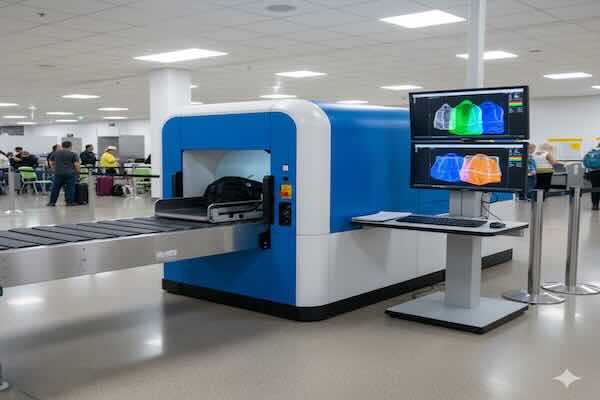
An airport security X-ray scanner is a shielded tunnel with a conveyor belt, an X-ray tube on one side and rows of detectors on the other. As a bag passes through, the detectors measure how much radiation each part of the bag absorbs, and software turns those measurements into a colour image for a trained screener. Airports combine these baggage scanners with body scanners, metal detectors, explosive trace detection and physical searches in a layered system. This page explains each layer, what the machines can and cannot detect, and how the technology is changing.
The screening layers at a passenger checkpoint
When people search for the "types of screening cameras at the airport", they usually mean a mix of very different machines. None of them is a camera in the photographic sense:
- Cabin-baggage X-ray (2-D or CT). Every carry-on bag goes through a conventional dual-energy X-ray scanner or, increasingly, a computed tomography (CT) scanner that builds a 3-D image.
- Body scanners (Advanced Imaging Technology, AIT). In the United States these are millimeter-wave scanners, which use non-ionizing radio waves, not X-rays. The older backscatter X-ray body scanners were removed from U.S. airports in 2013.
- Walk-through metal detectors (WTMD). Used alongside or instead of body scanners, for example for passengers in expedited lanes.
- Explosive trace detection (ETD). Swabs of hands, bags or items are analysed for explosive residue, usually by ion mobility spectrometry.
- Physical search and pat-downs. Used to resolve alarms that the machines cannot clear.
- Explosives detection dogs. Used at many airports, mostly for passenger and cargo screening in specific areas.
Checked (hold) baggage takes a separate, largely automated route through explosives detection systems behind the check-in desks — see checked baggage screening.
How a checkpoint X-ray machine works
A conventional checkpoint scanner is a line scanner. A collimated fan of X-rays passes through the bag onto an L-shaped array of detectors; as the belt moves the bag forward, the system builds the picture one slice at a time. "Dual-view" machines have a second source and detector array at an angle, giving the screener two projections of the same bag.
Most modern machines are dual-energy. Rather than two separate beams, they typically use a single tube operating at roughly 140–160 kV and a stacked ("sandwich") detector: the front layer records mostly lower-energy photons and the rear layer, behind a filter, records higher-energy photons. Comparing the two signals lets the software estimate the effective atomic number of each region and colour it accordingly.
What the colours mean
Manufacturers use slightly different palettes, but the common convention is:
- Orange: organic, low atomic number materials — clothing, food, paper, plastics, and also most explosives and drugs.
- Green: mixtures and lighter inorganic materials, or organic and inorganic items overlapping — for example aluminium or glass.
- Blue: inorganic and metallic materials such as steel.
- Black or opaque: areas too dense or too thick for the X-rays to penetrate — these always need a closer look.
Colour on its own does not identify a threat; a bag full of clothes is mostly orange. Screeners combine colour with shape, density and context. Our guide to X-ray image colours goes into more detail.
What airport X-ray can and cannot detect
TSA's public descriptions of its equipment are deliberately general, and detection performance figures are classified, so be sceptical of any website that quotes precise detection rates. In broad terms:
- Good at: weapons and dense metallic objects, knives, tools, batteries and electronics, liquid containers, and organic masses of an unusual shape or density.
- Harder: thin or sheet-like objects, items hidden in clutter or behind dense objects, and distinguishing harmless organic materials from explosives on a 2-D image. CT scanners and automated detection algorithms were introduced largely to address these limits.
- Not what it is for: identifying the exact chemical in a container. That is the role of ETD, bottled-liquid scanners and, ultimately, a manual search.
CT scanners at the checkpoint
TSA began testing checkpoint CT in 2017 at Phoenix Sky Harbor and Boston Logan, and has been replacing 2-D scanners as funding allows; by mid-2026 it reported more than 1,100 CT units at nearly 300 airports. CT produces a 3-D image the screener can rotate and slice, and its automated explosives detection algorithms can analyse liquids inside the bag. At many CT lanes travellers can leave laptops — and, where officers say so, their 3-1-1 liquids bag — inside the carry-on. The 3.4 oz (100 ml) container limit still applies in the U.S. In the EU, airports using approved "C3" CT equipment have been allowed to relax the 100 ml limit, but rules vary by airport. Details are on our CT checkpoint scanners page.
Threat Image Projection: keeping screeners sharp
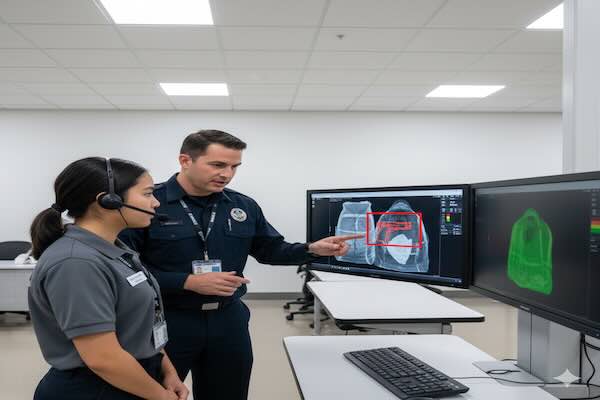
Real threats are rare at checkpoints, and research on visual search shows people miss rare targets more often. Threat Image Projection (TIP) counters this by occasionally inserting a stored image of a threat item into the image of a real bag. If the screener flags it, the system tells them it was a test; if not, the miss is recorded. TIP results are used for feedback, training and performance monitoring. Specific frequencies and pass marks are not public. For the cognitive side of the job, see X-ray image interpretation.
Body scanners
U.S. airports use millimeter-wave Advanced Imaging Technology. The scanner emits low-power radio waves and analyses the reflections to find objects hidden under clothing — metallic and non-metallic. Automated Target Recognition software shows the officer only a generic outline of a person with boxes on any areas that need checking, not an image of the passenger's body. Millimeter-wave energy is non-ionizing: there is no X-ray dose. See airport body scanners.
Is airport X-ray safe?
Baggage scanners are fully shielded cabinets. In the U.S. they must meet the FDA performance standard for cabinet X-ray systems (21 CFR 1020.40), which limits radiation leaking from the cabinet to 0.5 milliroentgen in one hour at 5 cm from any external surface. Passengers and staff standing next to a scanner receive a dose that is negligible compared with natural background radiation. Bags do not become radioactive. For film, cameras, medicines and food, see what airport X-ray does to film, electronics and food, and for the broader picture see radiation safety.
Prohibited items
What is banned depends on the country. In the U.S., TSA's "What Can I Bring?" tool is the authoritative list. For example, TSA prohibits knives in carry-on bags (except plastic or round-bladed butter knives), firearms and ammunition in carry-on bags, and liquids in containers larger than 3.4 oz (100 ml) in the cabin. In the EU and UK, the list is set by Regulation (EU) 2015/1998 and national rules. Always check the official list before you fly; this site does not reproduce it because it changes.
Who sets the rules
- United States: the TSA, under 49 CFR Chapter XII, operates checkpoints and tests and qualifies screening equipment. The FDA regulates the radiation safety of the X-ray products themselves.
- European Union: Regulation (EC) 300/2008 and Implementing Regulation (EU) 2015/1998 set common standards; equipment is tested through the ECAC Common Evaluation Process (CEP).
- Worldwide: ICAO Annex 17 sets the baseline international standards, which states implement nationally.
More on this on our regulations page. Want to test yourself? Try the aviation screening practice quiz.
Frequently asked questions
What kind of X-ray machine is used at airports?
Carry-on bags go through a shielded dual-energy line-scan X-ray machine or, increasingly, a CT scanner that produces a 3-D image. Checked bags are screened by automated explosives detection systems, most of which are also CT-based.
Do airport body scanners use X-rays?
Not in the U.S. or EU. Current body scanners use millimeter waves, which are non-ionizing radio waves. Backscatter X-ray body scanners were removed from U.S. airports in 2013.
Why do airport X-ray images show orange, green and blue?
Dual-energy scanners colour materials by effective atomic number: orange for organic materials, green for mixed or light inorganic materials, blue for metals, and black for areas too dense to penetrate.
Is the X-ray scanner safe for my bag and for me?
Yes. The scanner is a shielded cabinet that must meet FDA leakage limits in the U.S. The dose to a bag's contents is tiny and does not make anything radioactive; people next to the machine receive a negligible dose.
Sources and further reading
- TSA – Security screening technology
- TSA – Computed tomography
- TSA – What Can I Bring?
- eCFR – 21 CFR 1020.40 Cabinet X-ray systems
- EUR-Lex – Commission Implementing Regulation (EU) 2015/1998
- ICAO – Aviation security (Annex 17)
Last reviewed on 2026-10-04.