Airport security screening represents the most visible application of X-ray technology in transportation security. Since the Aviation and Transportation Security Act of 2001, the Transportation Security Administration (TSA) has deployed billions of dollars in advanced screening equipment across U.S. airports, evolving from basic two-dimensional imaging to sophisticated computed tomography and automated threat recognition systems.
Checkpoint Screening Architecture
Modern airport checkpoints employ a layered security approach integrating multiple technologies:
Primary Screening Lane Components
- Carry-On Baggage X-Ray: Dual-energy or CT systems for threat detection in passenger bags
- Passenger Screening: Millimeter wave Advanced Imaging Technology (AIT) body scanners
- Walk-Through Metal Detectors (WTMD): Secondary screening for metallic threat objects
- Explosive Trace Detection (ETD): Chemical analysis for residue screening
- Physical Pat-Down: Manual inspection protocol for alarm resolution
Checked Baggage Screening Infrastructure
All checked luggage undergoes mandatory explosive detection screening using:
- Explosive Detection Systems (EDS): High-resolution CT scanners certified for checked baggage
- Explosive Trace Detection (ETD) Portals: Secondary screening for flagged bags
- Canine Teams: Biological detection for complex threat scenarios
- Physical Inspection: Manual search by certified screening personnel
Dual-Energy X-Ray Systems
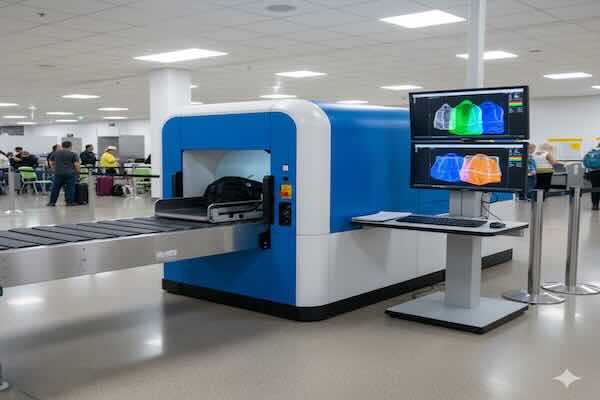
The current standard for checkpoint screening, dual-energy systems transmit X-rays at two energy levels (typically 80 keV and 160 keV) to enable material discrimination.
Technical Specifications
| Parameter | Specification |
|---|---|
| Tunnel Opening | 100 x 100 cm (standard), 65 x 50 cm (compact) |
| Belt Speed | 0.22 m/s (regulatory standard) |
| Steel Penetration | 34-38 mm equivalent |
| Wire Resolution | 38 AWG (0.1 mm diameter) |
| Throughput | 150-180 bags/hour |
| Power Requirement | 2.5-3.5 kW (120/240V AC) |
Color Coding Conventions
Dual-energy systems display material-specific colors to assist operator threat recognition:
- Orange/Brown: Organic materials (explosives, narcotics, food, plastics)
- Blue/Green: Inorganic materials (metals, ceramics, glass)
- Dark Blue/Black: High-density metals (steel, lead, dense electronics)
- Mixed Colors: Composite or layered materials requiring additional scrutiny
Computed Tomography (CT) Checkpoint Systems
Since 2018, TSA has approved CT technology for checkpoint deployment, representing the most significant advancement in baggage screening since 9/11.
Operational Advantages
- 3D Volumetric Imaging: 360-degree reconstruction allowing virtual bag dissection
- Automated Explosive Detection (AED): Algorithm-driven threat identification with >95% Pd
- Electronics-In-Bag Policy: Laptops, tablets, and liquids can remain packed (1-1-1 rule suspended)
- Enhanced Resolution: Sub-millimeter spatial resolution for complex threat geometries
- Reduced False Alarms: 3D analysis decreases bag-check rates by 30-40%
Deployment Status
As of 2026, TSA has deployed CT systems at major hub airports including:
- Hartsfield-Jackson Atlanta (ATL) - Category X
- Los Angeles International (LAX) - Tom Bradley Terminal
- O'Hare International (ORD) - Terminal 5
- Dallas/Fort Worth (DFW) - Multiple terminals
- John F. Kennedy (JFK) - Terminal 4
TSA Strategic Plan mandates CT deployment at all Category X and I airports by 2030.
Threat Image Projection (TIP)
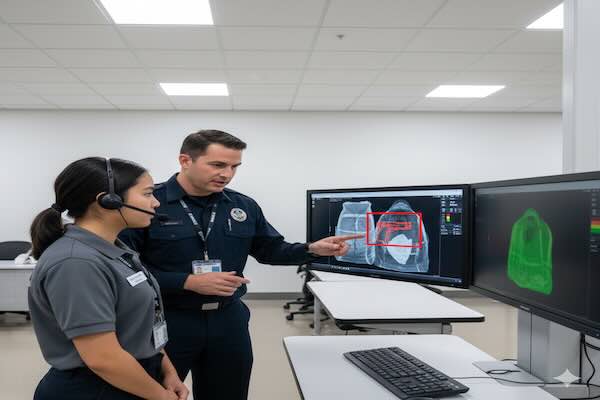
TIP is a TSA-mandated quality assurance program that superimposes synthetic threat objects onto live X-ray feeds to maintain operator vigilance and measure detection performance.
Program Requirements
- Frequency: Minimum 2 TIP images per operator per hour
- Threat Library: 100+ certified threat articles (firearms, IEDs, knives, prohibited items)
- Response Requirement: Operator must identify threat within 10 seconds
- Pass Threshold: 80% correct identification for certification maintenance
- Remedial Training: Automatic assignment for operators below 70%
Performance Metrics
TSA tracks operator performance through the Transportation Security Operations Center (TSOC):
- Individual Operator Score (IOS): Rolling 90-day TIP performance
- Checkpoint Performance Indicator (CPI): Aggregate screening lane metrics
- Certification Recurrency: Annual testing with live threat articles
Advanced Imaging Technology (AIT) Body Scanners
Millimeter wave body scanners replaced legacy backscatter X-ray systems in 2013, providing non-ionizing threat detection for concealed weapons and explosives.
Millimeter Wave Technology
- Frequency: 24-30 GHz (1-10 mm wavelength)
- Radiation Type: Non-ionizing radiofrequency (zero X-ray exposure)
- Scan Duration: 2-3 seconds for full-body imaging
- Detection Capability: Concealed metallic and non-metallic threats
- Privacy Protection: Automated Target Recognition (ATR) displays generic avatar
Deployment Models
- L3Harris ProVision 2: Single-pose active millimeter wave
- Smiths Detection eqo: Compact vertical scanner
- Rohde & Schwarz QPS: Passive millimeter wave (no transmission)
Prohibited Items and Threat Categories
TSA categorizes threats according to the National Explosives Detection Canine Team Program (NEDCTP) taxonomy:
Category A: Explosive Devices
- Improvised Explosive Devices (IEDs)
- Military ordnance and grenades
- Commercial explosives (C-4, TNT, PETN, RDX)
- Homemade explosives (TATP, HMTD, urea nitrate)
Category B: Firearms and Weapons
- Handguns, rifles, and shotguns (even if unloaded)
- Realistic firearm replicas
- Firearm parts (frames, receivers, slides)
- Ammunition over .75 caliber
Category C: Incendiaries and Flammables
- Liquids over 3.4 oz (100 ml) outside 1-quart bag
- Aerosol cans (except toiletries ≤3.4 oz)
- Lighter fluid and fuels
- Strike-anywhere matches
Category D: Sharp Objects
- Knives with blades >2.36 inches (6 cm)
- Box cutters and razor blades
- Ice picks and meat cleavers
- Swords and machetes
Operator Training and Certification
TSA screeners undergo comprehensive training before checkpoint assignment:
Initial Training Curriculum
- Classroom Instruction: 40 hours threat recognition theory
- X-Ray Image Interpretation: 80 hours supervised practice with certified trainers
- TIP Familiarization: 20 hours threat library review
- On-the-Job Training (OJT): 60 hours mentored screening operations
- Certification Testing: Written exam (80% pass) + practical demonstration
Continuing Education Requirements
- Annual Recertification: Live threat detection testing
- Quarterly Refresher Training: New threat pattern briefings
- TIP Performance Reviews: Weekly supervisor feedback sessions
- Advanced Threat Recognition: Specialized training for CT operators
Regulatory Compliance Framework
TSA Directives
- SD 1544-21-01: Passenger and Accessible Property Screening (current)
- SD 1544-04-04: Checked Baggage Screening
- 49 CFR Part 1540: Civil Aviation Security regulations
Equipment Certification
- Qualified Products List (QPL): TSA-approved checkpoint equipment
- Air Cargo Screening Technology List (ACSTL): Cargo-approved systems
- FDA 21 CFR 1020.40: Radiation safety standards for cabinet X-ray systems
Emerging Technologies
Artificial Intelligence Integration
Next-generation screening systems incorporate deep learning algorithms:
- Convolutional Neural Networks (CNNs): Automated threat classification with >98% accuracy in controlled testing
- Transfer Learning: Rapid adaptation to novel threat patterns without full retraining
- Anomaly Detection: Unsupervised learning identifies previously unseen threat configurations
- Real-Time Feedback: Operator assist mode highlights suspicious regions
Credential-Based Screening Programs
- TSA PreCheck: Expedited screening for pre-vetted low-risk travelers (12+ million members)
- CLEAR: Biometric identity verification partnered with TSA PreCheck
- Known Crewmember (KCM): Flight crew expedited access
- Trusted Traveler Programs: Global Entry, NEXUS integration
Contactless Screening Initiatives
Post-pandemic innovations reducing physical touchpoints:
- Automated bin return systems
- Self-service bag loading
- Touchless ID verification (CAT-2 systems)
- Mobile boarding pass integration
Cost and Infrastructure Considerations
Equipment Acquisition Costs
| System Type | Unit Cost (USD) | Annual Maintenance |
|---|---|---|
| Dual-Energy Checkpoint | $50,000 - $120,000 | $8,000 - $15,000 |
| CT Checkpoint | $300,000 - $500,000 | $40,000 - $60,000 |
| Checked Baggage EDS | $500,000 - $1,200,000 | $80,000 - $120,000 |
| Millimeter Wave AIT | $150,000 - $200,000 | $15,000 - $25,000 |
Infrastructure Requirements
- Electrical: Dedicated 30-60A circuits for CT systems
- HVAC: Additional cooling for high-heat equipment (CT, EDS)
- Spatial: Minimum 15-20 linear feet per checkpoint lane
- IT Integration: Network connectivity for central monitoring (TSOC)
- Radiation Shielding: Already integrated in cabinet design, no additional construction
International Standards Harmonization
U.S. airports serving international routes must comply with both TSA and ICAO Annex 17 standards:
ECAC Common Evaluation Process
- Standard 2: Basic explosive detection for hold baggage
- Standard 3: Enhanced threat detection (C-1 to C-4 explosive types)
- C-Point (C1-C5): Graduated security levels for checkpoint equipment
Mutual Recognition Agreements
TSA maintains bilateral security agreements enabling equipment cross-certification with:
- Transport Canada (CATSA screening standards)
- UK Department for Transport (DfT)
- European Civil Aviation Conference (ECAC) member states
- Australian Department of Home Affairs