An X-ray screener — or X-ray operator — is the person who reads the images from a baggage or cargo scanner and decides whether an item can be cleared or needs a closer look. In aviation, screeners must be trained and certified under national rules: in the U.S. by the TSA, in the EU and UK under Regulation (EU) 2015/1998 and its UK equivalent. This page explains what the job involves, how screener certification works on both sides of the Atlantic, and what to look for in X-ray training courses outside aviation.
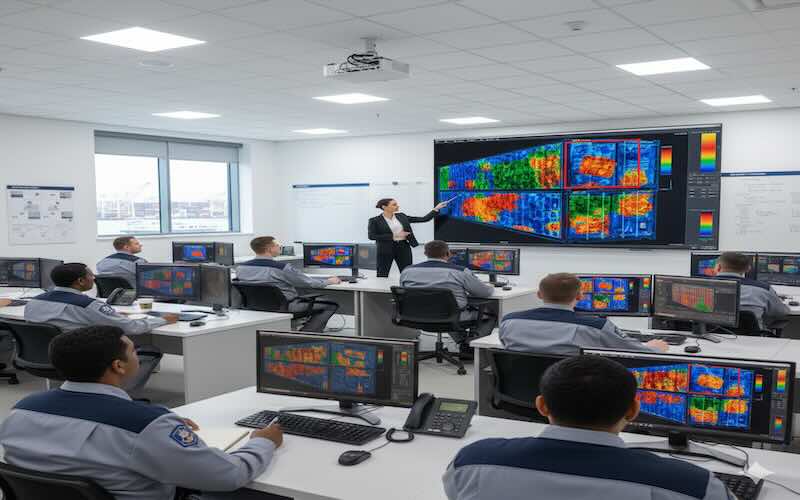
What does an X-ray screener do?
- Operates the X-ray or CT scanner and its image tools (zoom, material filters, multiple views).
- Interprets each image within a few seconds, looking for weapons, explosives, IED components and prohibited items — see X-ray image interpretation.
- Decides to clear the bag, request a second view, or send it for a physical search or explosive trace detection.
- Rotates between positions — image reading, bag search, body-scanner alarm resolution, document checks — to manage fatigue.
- Responds to Threat Image Projection (TIP) test images, which feed into performance monitoring.
TSA screener training and certification (United States)
At U.S. airports screening is done by Transportation Security Officers (TSOs), employed by TSA or, at Screening Partnership Program airports, by private contractors working to TSA standards.
Basic requirements
- U.S. citizen or U.S. national, at least 18 years old.
- High-school diploma or GED, or relevant security-screening experience.
- Passing TSA's computer-based test, which includes an X-ray object-recognition component.
- Background investigation, drug screening and a medical evaluation (including vision and hearing standards set by TSA).
Training path
- Home-airport orientation and online learning before formal training.
- TSO Basic Training — since 2016, a two-week in-person course at the TSA Academy at the Federal Law Enforcement Training Centers (FLETC) in Glynco, Georgia, with classrooms and mock checkpoints.
- On-the-job training at the home airport under supervision, followed by certification on the specific screening functions the officer will perform.
- Recurrent training and annual proficiency assessment, including image-interpretation practice and TIP performance.
There is no public "TSA X-ray certificate" that a civilian can buy: TSA certification is tied to employment as a screener. Private courses that advertise "TSA-approved X-ray training" for the general public should be checked carefully.
Screener certification in the EU and UK
Chapter 11 of Commission Implementing Regulation (EU) 2015/1998 sets the training and certification framework for aviation security staff in the EU (the UK kept an equivalent version after Brexit):
- Candidates complete a background check and initial training covering security awareness, prohibited articles and image interpretation.
- Screeners must pass a certification process, including an image-interpretation test for those who operate X-ray or EDS equipment, before working independently, and are re-certified periodically.
- Recurrent image-recognition training: operators of X-ray and EDS equipment must complete image-recognition training and testing — for classroom or computer-based training, at least six hours in every six-month period (known in the UK as "6×6"). Alternatively, on-the-job TIP training can be used under conditions set in the regulation.
National authorities (for example the UK CAA's Digital National X-ray Competency Test) run or approve the certification tests.
X-ray screening courses outside aviation
Courthouses, prisons, mailrooms, cruise terminals, ports and corporate security teams also use X-ray scanners. Requirements there are usually set by the employer, the facility's regulator or, for maritime facilities, national port-security rules. When choosing a course, look for:
- Hands-on time with a simulator or real images from the same type of scanner you will operate.
- A threat library that covers the items relevant to your setting (for example contraband in prisons, drugs and weapons in mail).
- A practical image-interpretation test, not only a written exam.
- Radiation-safety basics required by your local regulator for operating the equipment.
- Recurrent training: image-interpretation skill fades without regular practice.
Want a quick self-check? Try our free X-ray screening practice quiz.
Frequently asked questions
What is a screener in X-ray operation?
An X-ray screener is the trained person who operates a baggage, mail or cargo X-ray scanner and interprets the images to decide whether an item can be cleared or needs further checks.
How do I get screener certification?
In aviation, certification comes through employment: TSA certifies its Transportation Security Officers after basic training at the TSA Academy and on-the-job training; in the EU and UK screeners are certified under Regulation (EU) 2015/1998 by an approved national scheme.
Can I get a TSA X-ray certificate on my own?
No. TSA certification is linked to working as a screener. Private courses can teach X-ray interpretation, but they do not confer TSA certification.
How long is TSA screener training?
TSO Basic Training is a two-week course at the TSA Academy at FLETC in Glynco, Georgia, preceded by orientation and online learning and followed by on-the-job training and certification at the home airport.
What is 6x6 X-ray training?
Under EU and UK rules, X-ray and EDS operators doing classroom or computer-based recurrent training must complete at least six hours of image-recognition training and testing every six months.
Sources and further reading
- U.S. GAO-18-552 – TSO basic training program
- TSA – Transportation Security Officer careers
- EUR-Lex – Commission Implementing Regulation (EU) 2015/1998
- UK CAA – CAP 1171 Digital National X-ray Competency Test
Last reviewed on 2026-10-04.