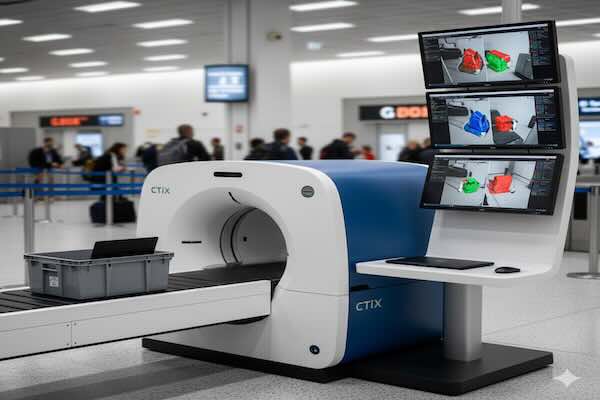
Computed tomography (CT) checkpoint scanners are the 3-D X-ray machines now replacing conventional 2-D carry-on bag scanners at many airports. Instead of one or two flat projections, a CT scanner reconstructs the whole bag as a volume that the screener can rotate and slice, and automated algorithms analyse the density and composition of what is inside. That is why, at many CT lanes, laptops can stay in the bag.
How checkpoint CT works
A conventional line scanner records one projection of the bag per X-ray source. A CT scanner records hundreds of projections from different angles — usually with an X-ray source and curved detector array mounted on a rotating gantry, the same principle as a medical CT scanner, while the belt moves the bag through. A reconstruction computer combines those projections into a stack of cross-sectional slices and a 3-D volume.
Because each small volume element (voxel) gets its own density estimate, CT removes most of the overlap problem that makes 2-D images hard to read. Most security CT systems also use dual-energy or spectral information, so the software can estimate both density and effective atomic number for each object. This is what allows automated explosives detection: the algorithm segments the bag into objects and flags those whose properties match explosive materials, including liquids.
CT compared with 2-D dual-energy X-ray
| Aspect | 2-D dual-energy | Checkpoint CT |
|---|---|---|
| Image | One or two flat projections | Full 3-D volume, rotatable and sliceable |
| Overlapping items | Major source of misses | Largely resolved by slicing |
| Explosives detection | Mainly operator judgement plus colour | Automated detection algorithms plus operator review |
| Laptops and liquids | Usually removed from bag | Can often stay in the bag (local rules apply) |
| Tunnel size | Often large | Can be smaller; some large carry-ons do not fit |
| Cost, weight, power | Lower | Considerably higher |
CT at U.S. checkpoints: the timeline
- 2017: TSA began testing checkpoint CT at Phoenix Sky Harbor and Boston Logan, using Analogic units donated with American Airlines' support.
- 2018: testing expanded to more airports, including a unit at New York JFK.
- 2019: TSA awarded Smiths Detection a contract for 300 checkpoint CT systems.
- 2021–2023: TSA placed larger orders under its Checkpoint Property Screening System programme, with base, mid-size and full-size CT systems from Analogic, Smiths Detection and others.
- 2026: TSA reported more than 1,100 CT units installed at nearly 300 airports, with replacement of the remaining 2-D fleet continuing as funding allows.
What CT means for passengers
- Laptops: at TSA CT lanes, laptops and larger electronics can normally stay in the bag.
- Liquids: in the U.S. the 3.4 oz (100 ml) container limit still applies. At CT lanes you may be told to leave your 3-1-1 bag inside — follow the officer's instructions.
- EU and UK: European rules allow airports with approved "C3" CT equipment to accept larger liquid containers (up to 2 litres). The EU withdrew this permission temporarily in 2024 and began restoring it for approved equipment in 2025, so the rule now depends on the airport and machine — check before you travel.
- Bag size: CT tunnels can be smaller than older X-ray tunnels, so oversized carry-ons may need to be screened differently or checked.
Which CT scanners are "best" for airports?
There is no public league table: detection performance data are classified, and approval is the regulator's decision. What matters is whether a system is qualified by TSA (U.S.) or has passed the ECAC Common Evaluation Process at the required standard for cabin baggage (EDSCB, with "C3" the level associated with relaxed liquid rules in Europe). Manufacturers with approved checkpoint CT systems include Smiths Detection, Analogic, Rapiscan Systems, Leidos and Nuctech. Ask vendors for their current approval status and test for the airport's own throughput and bag-size needs.
Limits of CT
- Algorithms only flag what they were designed and certified to detect; operators still review alarms and look for non-explosive threats such as knives and guns.
- Very dense items can cause image artefacts (streaks) that hide nearby objects.
- CT units are heavier, more expensive and use more power than 2-D scanners, which affects checkpoint layout.
For checked bags, CT has been standard for years — see checked baggage explosives detection systems. For the 2-D machines CT replaces, see checkpoint baggage scanners, and for the human side, image interpretation.
Frequently asked questions
Which airport X-ray machines produce 3-D images?
Computed tomography (CT) scanners. They reconstruct a full 3-D image of the bag that the officer can rotate and slice, unlike conventional 2-D dual-energy scanners.
When did TSA start using CT scanners at checkpoints?
TSA began testing checkpoint CT in 2017 at Phoenix Sky Harbor and Boston Logan, expanded testing in 2018, and has been deploying CT at scale since 2019.
Can I leave liquids in my bag at a CT lane?
In the U.S. the 3.4 oz (100 ml) limit still applies, but at CT lanes you may be allowed to leave the 3-1-1 bag inside your carry-on. In Europe some airports with approved C3 equipment allow larger containers. Always follow local instructions.
Are CT scanners safe?
Yes. They are shielded cabinet systems; the dose to the bag is small and the radiation outside the machine is negligible.
Sources and further reading
- TSA – Computed tomography
- TSA press release – CT installation, July 2026
- Smiths Detection – $96.8m TSA checkpoint CT contract (2019)
- Passenger Terminal Today – Analogic TSA checkpoint CT orders
- European Commission – Aviation security
Last reviewed on 2026-10-04.