Checkpoint X-ray scanners are the conveyor-fed machines that screen carry-on bags at airports, and the same basic design is used at courthouses, government buildings, mail rooms and event venues. This guide explains the main types of baggage scanner — single-energy, dual-energy, multi-view and CT — how the X-ray "transmitter" and "receiver" actually work, and what the operator sees on screen.
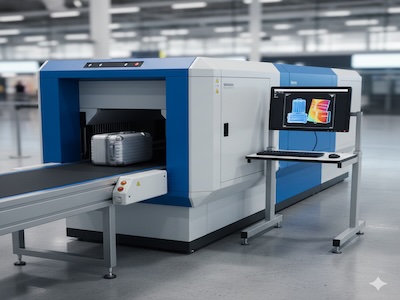
How a baggage X-ray scanner works: source and detectors
Every conventional baggage scanner has the same three building blocks:
- The "transmitter" — an X-ray generator. A sealed X-ray tube, typically operating somewhere around 140–160 kV in aviation-grade machines (lower in small mailroom units), produces X-rays. A collimator shapes them into a thin, flat fan beam that crosses the tunnel.
- The "receiver" — a detector array. On the opposite side of the tunnel, usually bent into an L-shape along the side and top, sits a line of detectors: scintillator crystals that convert X-ray photons into light, coupled to photodiodes that convert the light into an electrical signal. Each detector element becomes one pixel column of the image.
- The conveyor and computer. As the belt moves the bag through the fan beam, the system reads the detector line many times per second and stacks those lines into a 2-D image. Software then applies colour, contrast and edge enhancement before the image appears on the operator's monitor.
The whole tunnel is a shielded cabinet with lead curtains at the entrance and exit, and interlocks that cut the X-rays if a panel is opened. In the U.S. such machines must meet the FDA cabinet X-ray standard (21 CFR 1020.40).
Types of baggage X-ray scanner
Single-energy scanners
Single-energy machines measure one total attenuation value per pixel and produce a greyscale image that shows density and thickness, but cannot tell materials apart. A thick book and a thin steel plate can look the same. Single-energy units still exist in low-cost and small-tunnel applications, but most security baggage scanners sold today are dual-energy; aviation authorities effectively require material discrimination for cabin baggage screening.
Dual-energy scanners
Dual-energy scanners record how much the bag absorbs at two different photon energies. The usual design uses one tube and a stacked detector: a thin front layer responds mainly to lower-energy photons, then a filter, then a rear layer that sees the higher-energy part of the spectrum. Low-atomic-number (organic) materials absorb the two energies in a different ratio from metals, so the software can estimate an effective atomic number (Zeff) for each pixel and colour it:
| Display colour | Material class | Typical examples |
|---|---|---|
| Orange | Organic (low Z) | Clothing, food, paper, plastics, liquids; also explosives and drugs |
| Green | Mixed / light inorganic | Aluminium, glass, overlapping organic and metal items |
| Blue | Inorganic / metals | Steel tools, coins, wiring, battery casings |
| Black / opaque | Not penetrated | Very thick or dense objects — always need a closer look |
The colours are a convention, not a standard, and vary slightly between manufacturers. See X-ray image colours explained.
Multi-view (dual-view) scanners
A dual-view scanner has two X-ray sources and two detector arrays, typically one looking up from below and one looking across from the side. The operator sees two projections at once, so an object hidden behind something dense in one view is often visible in the other. Dual-view machines are common at airport checkpoints.
Computed tomography (CT) scanners
CT scanners rotate the source and detectors around the bag (or use many fixed sources) to reconstruct a full 3-D volume. Operators can rotate and slice the image, and automated algorithms can analyse the density and composition of objects, including liquids inside the bag. CT is replacing 2-D scanners at many large airports; see CT checkpoint scanners.
Tunnel size classes
Manufacturers name many models after the tunnel opening in centimetres — for example a "6040" (about 60 × 40 cm) for handbags and mail, "10080" or "100100" for checkpoint and larger hold-baggage pieces. Larger tunnels need more powerful sources to achieve the same penetration.
Image tools available to the operator
- Zoom and pan to inspect a region in detail.
- Organic-only / inorganic-only ("organic stripping") views to remove one material class from the image.
- Greyscale and inverse views, which some operators find easier for spotting thin wires.
- High-penetration or variable-contrast settings to look into dense regions.
- Automated detection aids on newer systems that outline regions the software considers suspicious, such as possible explosives or laptops.
- Threat Image Projection (TIP), which inserts fictional threat images to keep operators alert and measure performance.
Measuring image quality
Buyers and regulators check scanners with standard test objects rather than taking brochure claims at face value. In the U.S., ASTM F792 describes a test kit and procedure for evaluating the imaging performance of security X-ray systems, covering things like wire resolution, steel penetration and organic/inorganic discrimination. Daily image-quality checks with a test piece are a normal part of operating a checkpoint scanner. Aviation equipment is additionally tested by the regulator (TSA in the U.S., the ECAC Common Evaluation Process in Europe) against non-public detection requirements.
Main manufacturers
The global aviation baggage-scanner market is dominated by a handful of companies, including Smiths Detection, Rapiscan Systems (OSI Systems), Leidos (which acquired L3 Security & Detection Systems in 2020), Analogic and Nuctech, with many smaller manufacturers serving non-aviation markets. Which models are approved for a given airport depends on the national regulator — in the U.S., on TSA qualification. Compare equipment categories on our equipment overview.
Radiation safety
A properly maintained baggage scanner leaks very little radiation; U.S. rules cap leakage at 0.5 mR per hour at 5 cm from the cabinet surface. Operators in most countries are not classed as radiation workers for this equipment. Film, electronics and food are discussed on what airport X-ray does to film, electronics and food, and general principles on our safety page.
Frequently asked questions
What are the main types of X-ray baggage scanner?
Single-energy (greyscale), dual-energy (colour-coded by material), multi-view (two or more projections at once) and CT (full 3-D). Dual-energy single- or dual-view machines are the most common; CT is spreading at large airports.
Do most companies use single-energy X-ray to scan baggage?
No. Single-energy greyscale scanners are now mainly low-cost or small-tunnel units. Airports and most security buyers use dual-energy machines because they can distinguish organic materials from metals.
How do the transmitter and receiver work in a dual-energy scanner?
The transmitter is an X-ray tube that sends a thin fan beam across the tunnel. The receiver is a line of scintillator detectors, usually stacked in two layers separated by a filter, so the front layer records lower-energy and the rear layer higher-energy X-rays. The ratio between them indicates the material.
Can an X-ray scanner see through everything?
No. Very thick or dense items appear black because the X-rays do not get through. Operators must inspect such areas by changing the view, using another technology or searching the bag.
Sources and further reading
- TSA – Security screening technology
- eCFR – 21 CFR 1020.40 Cabinet X-ray systems
- ASTM F792 – Evaluating the imaging performance of security X-ray systems
- ECAC – Common Evaluation Process for security equipment
- EU Joint Research Centre – X-ray baggage screening and artificial intelligence (2022)
Last reviewed on 2026-10-04.