Checkpoint X-ray baggage scanners represent the primary defense layer in aviation security, screening over 2 billion carry-on bags annually at U.S. airports. Modern dual-energy systems provide material discrimination capabilities that enable screeners to identify threats while maintaining throughput of 250-400 bags per hour per lane.
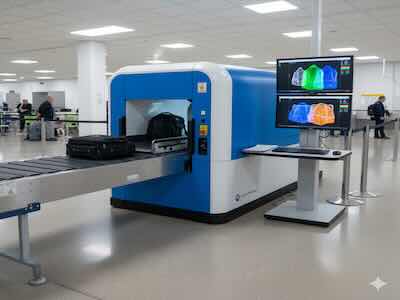
TSA-certified checkpoint X-ray scanner with dual-energy imaging
System Architecture and Components
Core Components
- X-Ray Generator: 80-160 kVp dual-energy tube with automatic exposure control
- Detector Array: Linear diode array or flat-panel detector (1024-2048 pixels)
- Conveyor System: Variable speed belt (0.15-0.25 m/s) with automatic bag spacing
- Tunnel Enclosure: Lead-lined cabinet providing radiation shielding and baggage containment
- Operator Console: High-resolution monitor (minimum 1920x1080) with image manipulation tools
- TIP System Integration: Threat Image Projection for operator performance monitoring
Dual-Energy Technology
Modern checkpoint scanners employ dual-energy X-ray transmission to enable material discrimination:
Operating Principles
- Low Energy (60-80 keV): Preferentially absorbed by organic materials
- High Energy (120-160 keV): Penetrates dense materials more effectively
- Absorption Ratio Analysis: Software calculates material Zeff (effective atomic number)
- Color Mapping: Automatic assignment of colors based on material classification
Standard Color Coding
| Material Type | Display Color | Examples |
|---|---|---|
| Organic (Low Z) | Orange/Brown | Explosives, drugs, food, plastics, paper |
| Inorganic (Medium Z) | Green/Blue | Aluminum, glass, ceramics, light metals |
| Metals (High Z) | Blue/Black | Steel, copper, lead, firearms, dense metals |
| Mixed/Composite | Multi-color | Electronics, batteries, complex assemblies |
Technical Specifications
Standard Checkpoint Scanner Specifications
| Parameter | Typical Value |
|---|---|
| Tunnel Size (W x H) | 100 x 100 cm (standard) / 65 x 50 cm (compact) |
| Belt Speed | 0.20-0.22 m/s (adjustable) |
| Penetration (Steel) | 34-38mm minimum (TSA requirement) |
| Wire Resolution | 38 AWG (0.1mm diameter) detectability |
| Spatial Resolution | 1.0-1.5 mm (IEC 62523 standard) |
| X-Ray Generator | 80/160 kVp dual-energy, 0.8-1.2 mA |
| Throughput | 250-400 bags/hour (operator dependent) |
| Power Consumption | 1.5-3.0 kW (idle/scanning) |
| Weight | 800-1500 kg (model dependent) |
Image Processing Capabilities
- Zoom: Digital magnification up to 64x
- Image Enhancement: Edge enhancement, smoothing, histogram equalization
- Material Stripping: Selective removal of organic/inorganic materials from display
- High Penetration Mode: Increased kVp for dense bags
- Super Resolution: AI-enhanced detail rendering
- Multi-View: Horizontal/vertical beam angles (dual-view systems)
TSA Certification Requirements
Qualified Products List (QPL) Process
All checkpoint screening equipment deployed at U.S. airports must appear on TSA's Qualified Products List:
Certification Phases
- Manufacturer Submission: Technical documentation and performance claims
- Laboratory Testing: Controlled testing at TSA Systems Integration Facility
- Operational Pilot: Live airport deployment (3-6 months)
- Data Analysis: Performance evaluation against detection/false alarm requirements
- Qualification Decision: Addition to QPL or rejection with feedback
Performance Requirements
- Probability of Detection (Pd): ≥95% for representative threat articles
- False Alarm Rate (FAR): ≤5% to maintain throughput efficiency
- Image Quality: IEC 62523 compliance for wire detectability and penetration
- Reliability: MTBF (Mean Time Between Failures) ≥2000 hours
- Radiation Safety: FDA 21 CFR 1020.40 compliance (≤0.5 mR/hr leakage)
International Certifications
- ECAC Standard 3: European certification for cabin baggage screening
- ICAO Compliance: Annex 17 screening requirements
- Civil Aviation Authorities: Individual country approvals (CAAC China, DGCA India, etc.)
Leading Manufacturers and Systems
Smiths Detection
HI-SCAN Series
- HI-SCAN 6040i: Compact tunnel (60x40cm), ideal for cabin baggage pre-screening
- HI-SCAN 10080 XCT: Standard checkpoint, dual-energy with material discrimination
- HI-SCAN 100100T-2is: Large tunnel (100x100cm), high-penetration for oversized carry-ons
- Key Features: iCMORE software suite, automatic threat detection algorithms, network management
Rapiscan Systems (OSI Systems)
600 Series and RTT
- Rapiscan 620DV: Dual-view imaging (horizontal + vertical beams) for complete bag coverage
- Rapiscan 628XR: Standard checkpoint with enhanced material discrimination
- RTT 110: Real-time tomography (pseudo-CT) for improved threat detection
- Key Features: EagleTrac software, remote screening capability, TIP integration
Analogic (Safran)
Cobra Series
- Cobra CT: Advanced checkpoint CT scanner (see CT scanners page for details)
- eXaminer XLB: Dual-energy conventional checkpoint scanner
- Key Features: Advanced threat detection, automated bin return, high throughput
L3Harris (Integrated Security Solutions)
ClearScan and DAXX
- ClearScan 100100: Standard tunnel with advanced image processing
- DAXX Multi-Energy: Spectral imaging beyond traditional dual-energy
- Key Features: Explosive detection algorithms, remote image review, baggage tracking
Operational Deployment
Installation Requirements
Physical Infrastructure
- Floor Space: Minimum 5-7 meters length including roller tables
- Floor Loading: 200-300 kg/m² capacity required
- Ceiling Height: 2.5 meters minimum for equipment and maintenance access
- Power: 208-240VAC, 20-30A dedicated circuit per unit
- HVAC: Climate control (15-25°C operating range, ≤80% humidity)
Network Infrastructure
- Ethernet Connectivity: Gigabit network for image transfer and TIP
- Central Server: Image archival and remote screening capability
- TIP Integration: Connection to TSA threat library servers
- Cybersecurity: Isolated network segment, encrypted communications
Operator Training
Comprehensive training programs required for certification:
- Initial Training: 40-80 hours including classroom and hands-on practice
- Threat Recognition: Pattern recognition for IEDs, firearms, prohibited items
- Image Interpretation: Material discrimination, density analysis, layering assessment
- Equipment Operation: System controls, image manipulation, alarm resolution
- Annual Recertification: Competency testing and refresher training
Maintenance and Calibration
Preventive Maintenance Schedule
| Frequency | Tasks |
|---|---|
| Daily | Image quality test with IEC test piece, conveyor inspection, visual checks |
| Weekly | Penetration verification, resolution test, cleaning of tunnel and rollers |
| Monthly | Belt tension adjustment, interlock testing, software updates |
| Quarterly | Calibration verification, detector alignment, X-ray tube assessment |
| Annually | Radiation survey (state requirement), comprehensive system inspection, major component replacement as needed |
Common Maintenance Issues
- Conveyor Belt Wear: Replacement every 18-36 months depending on volume
- X-Ray Tube Life: 8,000-15,000 hours typical lifespan
- Detector Degradation: Pixel failures requiring detector replacement (5-10 years)
- Software Updates: Quarterly threat library and algorithm updates from manufacturer
Cost Analysis
Capital Equipment Costs
| System Type | Price Range (USD) |
|---|---|
| Compact Checkpoint (60x40cm) | $40,000 - $70,000 |
| Standard Checkpoint (100x100cm) | $80,000 - $150,000 |
| Dual-View System | $120,000 - $200,000 |
| Advanced Multi-Energy | $150,000 - $250,000 |
Total Cost of Ownership (5 Years)
- Equipment Purchase: $100,000 (baseline standard system)
- Installation and Integration: $15,000 - $30,000
- Annual Maintenance Contract: $8,000 - $15,000/year
- Power and Utilities: $2,000 - $4,000/year
- Operator Training: $5,000 - $10,000 initial + $2,000/year recurrent
- Consumables: $3,000 - $5,000/year (belts, rollers, test pieces)
- Total 5-Year TCO: $190,000 - $290,000
Future Technology Trends
Artificial Intelligence Integration
- Automated Threat Detection: AI algorithms achieving >98% detection with lower false alarms
- Deep Learning: Convolutional neural networks trained on millions of threat images
- Operator Assist: Highlighting suspicious areas for human review
- Adaptive Screening: Risk-based processing speeds based on bag content
3D and Volumetric Imaging
- Transition to CT: Full 3D reconstruction replacing 2D dual-energy
- Virtual Bag Dissection: Multi-planar slicing without physical bag opening
- Improved Detection: Eliminating bag orientation limitations
Increased Automation
- Automated Bin Handling: Robotic divest and bag return
- Remote Screening: Centralized image analysis from multiple checkpoints
- Contactless Operations: Reduced operator intervention for COVID-era operations