The full-body scanner you step into at a U.S. or European airport checkpoint is an Advanced Imaging Technology (AIT) unit that uses millimeter waves — low-power radio waves, not X-rays. It looks for objects hidden under clothing, metallic or not, and shows the officer only a generic outline of a person with boxes on any area that needs checking. This page explains how millimeter-wave scanners work, what they detect, how they differ from the backscatter X-ray scanners they replaced, and what passengers can expect.
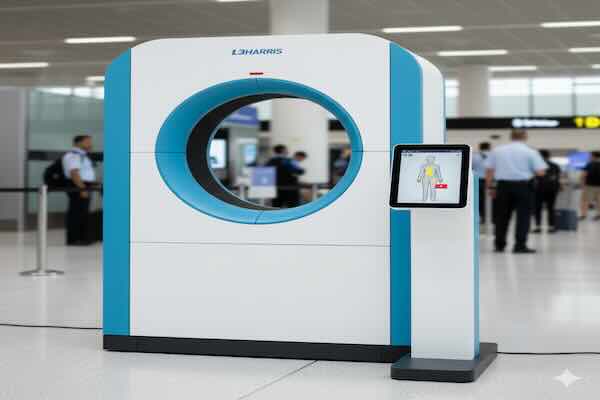
How a millimeter-wave body scanner works
Millimeter waves sit between microwaves and infrared light, at frequencies of roughly 30–300 GHz in the strict definition; security scanners typically operate in the tens of gigahertz (the widely deployed ProVision family is described in published literature as working at roughly 24–30 GHz). At these frequencies the waves pass through clothing but are reflected by skin and by most objects carried against the body.
- The passenger stands in the portal with arms raised for a couple of seconds.
- Antenna arrays transmit low-power millimeter-wave signals and record the reflections from many angles — in the ProVision design, two panels sweep around the passenger.
- Software reconstructs a three-dimensional surface image from the reflections (this is sometimes called holographic imaging).
- Automated Target Recognition (ATR) software analyses that image for anomalies — anything that is not body — and the raw image is not shown to the officer.
- The officer's screen shows a generic figure, identical for everyone, either with an "OK" or with boxes marking areas to pat down.
Because the scanner forms a 3-D surface model, the answer to the common exam question "a millimeter-wave scanner produces an image of the body in how many dimensions?" is three. A backscatter X-ray scanner, by contrast, produces a two-dimensional image of each side of the body.
What body scanners can and cannot detect
- Can detect: objects on the body under clothing — metallic and non-metallic, including weapons, liquids, gels, powders and packages. TSA describes ATR as able to detect items such as liquids, gels, plastics, powders, metals and ceramics.
- Cannot detect: items inside body cavities or swallowed, since millimeter waves do not penetrate skin.
- Common harmless alarms: items left in pockets, thick seams, hair accessories, sweat, padded clothing, and some medical devices and prostheses.
Detection rates are not published by TSA. Treat any precise percentage you see online with caution.
Is a millimeter-wave scanner safe?
Millimeter waves are non-ionizing: they do not have enough energy to break chemical bonds or damage DNA, and there is no X-ray dose. The emitted power is very low and the exposure lasts only seconds; TSA states the technology has no known adverse health effects. Pregnant travellers and people with implants can use the scanner, though anyone can ask for alternative screening.
Backscatter versus millimeter wave
| Aspect | Backscatter X-ray | Millimeter wave |
|---|---|---|
| Radiation | Ionizing (very low-dose X-rays) | Non-ionizing radio waves |
| Image | 2-D, front and back | 3-D surface model |
| Privacy software | Vendor could not deliver ATR by the deadline | ATR generic outline |
| U.S. airport status | Removed in 2013 | Standard AIT technology |
Backscatter is still used for vehicle inspection and in some prisons and military checkpoints — see backscatter X-ray imaging.
Manufacturers
- Leidos ProVision (formerly L3 Security & Detection Systems, acquired by Leidos in 2020): the main AIT deployed by TSA and used at many airports worldwide.
- Rohde & Schwarz QPS: an active millimeter-wave scanner using a flat panel; widely used at European airports, with walk-through variants for other venues.
- Smiths Detection eqo: a flat-panel millimeter-wave system used in some markets.
- Passive systems (for example stand-off terahertz or millimeter-wave cameras that only detect the body's natural emission) are used mainly outside aviation, at events and transport hubs.
What passengers can expect
- In the U.S. you may decline AIT screening and receive a pat-down instead (some passengers may be required to use AIT under specific security procedures). You can ask for a private screening and for a same-gender officer to perform any pat-down.
- Remove everything from your pockets before entering; this is the most common cause of alarms.
- Tell the officer about medical devices, insulin pumps or prostheses.
- Children and travellers who cannot stand with arms raised may be screened by other means.
- In the EU, security scanners are permitted under Commission Regulation (EU) No 1141/2011 and must not store or copy images; passengers are generally allowed to opt for an alternative screening method.
For the rest of the checkpoint, see airport security screening, and test your knowledge with our screening practice quiz.
Frequently asked questions
What is an AIT full body scanner?
AIT stands for Advanced Imaging Technology. At U.S. and EU airports it is a millimeter-wave scanner that detects metallic and non-metallic items under clothing and shows officers only a generic outline with boxes on areas that need a pat-down.
Do airport body scanners use X-rays?
No. Current airport body scanners use millimeter waves, which are non-ionizing radio waves. Backscatter X-ray body scanners were removed from U.S. airports in 2013.
In how many dimensions does a millimeter-wave scanner image the body?
Three. A millimeter-wave scanner builds a 3-D surface model from reflections recorded at many angles. A backscatter X-ray scanner produces two-dimensional images.
What frequency do TSA millimeter-wave scanners use?
Published descriptions of the ProVision scanners used by TSA put them at roughly 24–30 GHz, at very low power. They are non-ionizing and TSA states there are no known adverse health effects.
Can I refuse the body scanner?
In the U.S. most passengers may opt out and receive a pat-down instead. In the EU passengers are generally offered an alternative screening method.
Sources and further reading
- TSA – Security screening (AIT)
- Federal Register – Passenger Screening Using Advanced Imaging Technology (2013)
- Congressional Research Service – Airport Body Scanners (R42750)
- EUR-Lex – Commission Regulation (EU) No 1141/2011 on security scanners
Last reviewed on 2026-10-04.